

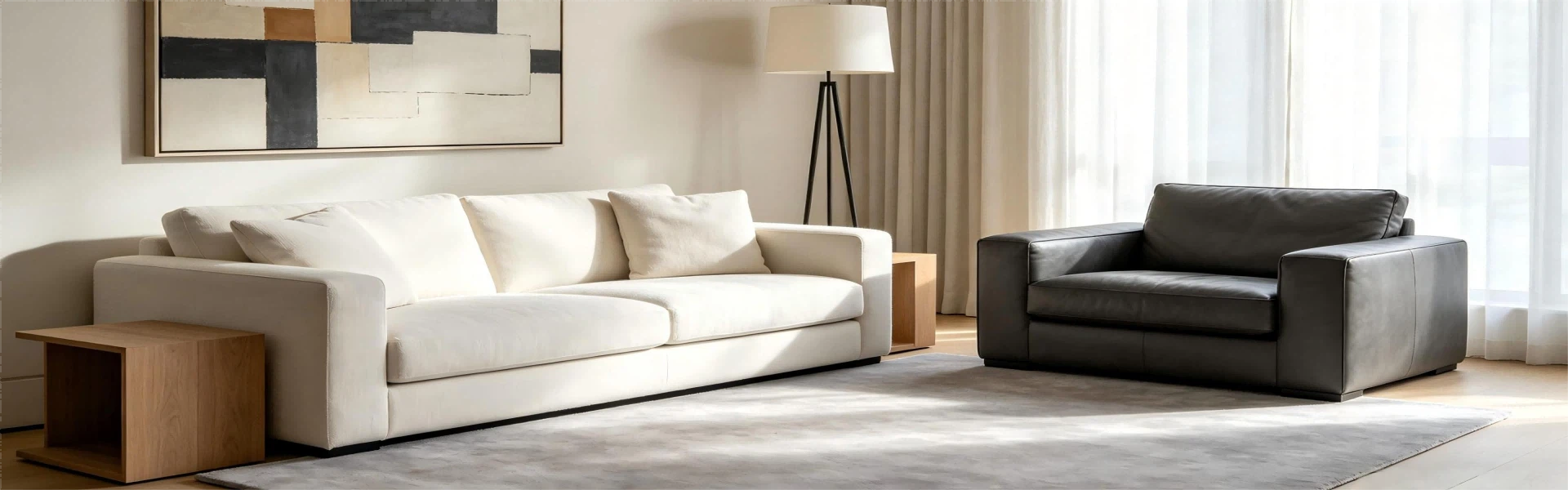
What leather material is best for Sectional Sofa?
Apr 16, 2025
Leave a message
Preface
In modern home decoration, Sectional Sofa is not only the core furniture of daily life, but also a symbol of family taste. As consumers' requirements for quality of life increase, leather sofas have become the first choice for many families due to their luxurious texture, durability and easy cleaning. However, there are many types of leather materials on the market, from natural leather to artificial leather, with huge price differences and different performances. Which leather material is most suitable for sofas? How should consumers choose according to their needs? This article will start from a scientific perspective, combine market research and industry standards, systematically analyze the material characteristics of leather sofas, and provide consumers with a practical purchase guide.

The core value and market demand of leather sofas
Since their birth, leather sofas have been closely linked to labels such as "high-end" and "classic". Its core advantages are:
Texture and comfort: The breathability and soft touch of natural leather are far better than fabric sofas, especially in terms of warmth in winter and heat dissipation in summer.
Durability: High-quality leather is durable and can last for more than 10 years under normal use. Over time, it will form unique "traces of use" (i.e. "patina"), adding a retro aesthetic.
Easy to clean: Compared with fabric sofas, the leather surface is not easy to absorb dust, and stains can be wiped directly, which is suitable for families with pets or children.
According to the "2023 Global Home Market Report", leather sofas account for more than 35% of the high-end furniture market, with the fastest demand growth in the Asia-Pacific region, with an annual growth rate of 12%. However, consumers still have misunderstandings about leather materials, such as confusing the performance differences between "genuine leather" and "artificial leather", or ignoring environmental and health issues.
Natural leather: synonymous with high-end sofas
2.1 Top cowhide: a symbol of top quality
The top cowhide is the "ceiling" of leather for sofas. It is taken from the cow's epidermis and retains the complete structure of natural fibers. Its characteristics include:
Breathability: It contains about 5,000 tiny pores per square centimeter, which can regulate humidity and temperature.
Abrasion resistance: It can pass the Martindale abrasion test (Martindale Test) for more than 100,000 times.
Price: The price per square meter is about 300-800 yuan, and high-end brands can reach more than 1,000 yuan.
But it should be noted that there are also grades in the top cowhide. Full Grain is the highest grade because it is not polished and retains its original texture. Top Grain is slightly processed and has a higher cost-effectiveness.
2.2 Split Leather and Regenerated Leather: The Best Choice for Cost-effectiveness
Split leather is made of leather scraps, and the surface needs to be covered with PU coating to imitate the texture of leather. Its advantage is that it is cheap (50-150 yuan per square meter), but it has poor air permeability and is prone to cracking after long-term use. Regenerated leather is made by breaking up the leather scraps and re-gluing them. Its performance is even worse and it is suitable for consumers with limited budgets.
2.3 Other Animal Leathers: The Favorite of the Niche Market
Sheepskin: Soft and delicate, but poor wear resistance, mostly used for decorative sofas.
Horse Leather: Large pores, rough style, suitable for industrial style design.
Crocodile/Ostrich Leather: Luxury-grade materials, expensive and require special maintenance.
Artificial leather: a combination of technology and practicality
3.1 PVC leather: economical and durable but questionable environmental protection
PVC (polyvinyl chloride) leather is the earliest type of artificial leather, made by coating PVC resin on the base fabric. Its advantages are waterproof and wear-resistant (wear-resistant test up to 50,000 times), and the price is only 1/10 of that of genuine leather. However, PVC production may release harmful substances such as dioxins, and the EU has restricted its application in the furniture field.
3.2 PU leather: balancing performance and price
PU (polyurethane) leather is covered with a microporous polyurethane layer on the base fabric, which feels close to genuine leather and has better breathability than PVC. High-end PU leather can even pass the "leather burning test" (genuine leather smells like burnt hair after burning, and PU leather smells like plastic). At present, PU leather occupies the mainstream of the mid-end market, with a price of about 80-200 yuan per square meter.
3.3 Microfiber leather: "light luxury" in artificial leather
Microfiber leather (abbreviated as microfiber leather) uses microfiber non-woven fabric as the base material to imitate the three-dimensional mesh structure of genuine leather. Its wear resistance (more than 150,000 times) and tear resistance are better than ordinary leather, and it is more environmentally friendly. It is widely used in car seats and high-end furniture.
Environmental protection and health: the rise of emerging materials
4.1 Vegetable tanned leather: a trend back to nature
Traditional leather tanning uses chromium salts, which may leave heavy metals. Vegetable tanning uses tannins and bark extracts. Although the cost increases by 30%, it meets the EU REACH environmental protection standards and is especially suitable for families with children.
4.2 Water-based PU leather: a solution for low VOC emissions
Traditional PU leather uses solvent-based coatings and has high VOC (volatile organic compounds) emissions. Water-based PU leather uses water as a solvent, reduces VOC emissions by 90%, and has passed the Greenguard Gold Certification.
Buying Guide: How to choose leather materials according to needs?
Demand scenario Recommended material Reason
Sufficient budget, pursuit of luxury Full-grain cowhide Durability, breathability, collection value
House with pets or children Microfiber leather or water-based PU leather Anti-scratch, easy to clean, environmentally friendly and safe
Renting or short-term use Second-layer leather/PVC leather Low cost, small depreciation loss when moving
Future trends: Innovative direction of leather materials
Bio-based synthetic materials: such as mushroom leather (Mycelium) and cactus leather (Desserto), which are both environmentally friendly and high-performance.
Smart leather: embedded sensors can adjust temperature or monitor sitting posture health.
Conclusion
When choosing sofa leather materials, you need to consider the budget, usage scenarios and values. Whether it is the classic texture of natural leather, the technological breakthrough of artificial leather, or the future potential of emerging environmentally friendly materials, consumers should find the most suitable answer for themselves in rational analysis. With the advancement of technology and the enhancement of environmental awareness, "sustainable luxury" may become the next keyword in the home furnishing industry.